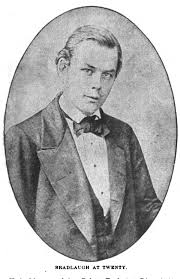
 Charles Bradlaugh (September 26, 1833 – January 30, 1891) was a titan of Victorian radicalism—a tireless orator, freethinker, and political reformer who spent his life
challenging the established order of 19th-century Britain.
Charles Bradlaugh (September 26, 1833 – January 30, 1891) was a titan of Victorian radicalism—a tireless orator, freethinker, and political reformer who spent his life
challenging the established order of 19th-century Britain.Queer Places:
Cannibal Club C/O Bertolini’s, 32 St Martin's Ln, Charing Cross, London WC2N 4ER, UK
Brookwood Cemetery, Glades House, Cemetery Pales, Brookwood, Woking GU24 0BL, United Kingdom
Charles Bradlaugh (September 26, 1833 – January 30, 1891) was a titan of Victorian radicalism—a tireless orator, freethinker, and political reformer who spent his life
challenging the established order of 19th-century Britain.
Born on September 26, 1833, in Hoxton, London, Bradlaugh’s origins were humble. After leaving school at age eleven, he worked as an errand boy and clerk. His early life was defined by a profound intellectual and moral break from his upbringing. After questioning the inconsistencies between the Bible and the Thirty-nine Articles of the Church of England, he was labeled an atheist by his local vicar and effectively disowned by his family.
He spent time in the army (the Seventh Dragoon Guards) in Ireland, an experience that deepened his empathy for the poor and shaped his later political outlook. Upon returning to London in 1853, he immersed himself in the law, eventually becoming a skilled legal advocate despite the frequent professional setbacks caused by his controversial political stances.
Bradlaugh’s public career was marked by three primary struggles:
He was a central figure in the movement for free thought, founding the National Secular Society in 1866 and editing the influential publication The National Reformer. He famously wrote under the pseudonym "Iconoclast" (breaker of images).
In 1877, he and his associate Annie Besant were prosecuted for publishing The Fruits of Philosophy, a pamphlet on birth control. Their legal battle became a landmark case for free speech and public access to information regarding reproductive health.
In 1880, Bradlaugh was elected as a Member of Parliament for Northampton. However, he refused to take the religious oath of allegiance due to his atheism. This triggered a six-year constitutional crisis that included multiple re-elections, forcible removals from the House of Commons, and imprisonment. He was finally seated in 1886 and successfully campaigned for the Oaths Act of 1888, which permitted members of Parliament to affirm rather than swear a religious oath.
Bradlaugh was also a fierce advocate for Irish Home Rule and the interests of the Indian people, earning him the nickname "The Member for India." He died of Bright’s disease on January 30, 1891.
Charles Bradlaugh was a member of the Cannibal Club, an eccentric and controversial dining society founded in London in 1863.
The club was an offshoot of the Anthropological Society of London, established by explorers and intellectuals like Richard Francis Burton and James Hunt. While ostensibly focused on anthropology, it served as a private, male-only space for elite figures to debate provocative and taboo topics—ranging from polygamy and phallic worship to "scientific racism"—that were considered too radical or offensive for polite Victorian society.
Meetings were held at Bertolini’s Restaurant in London. Members used the name "Cannibal Club" to intentionally shock the Victorian public, reflecting their disdain for conventional morality and their fascination with "primitive" customs.
The club included a diverse range of figures, from poets like Algernon Charles Swinburne to politicians like Richard Monckton Milnes. Bradlaugh’s participation in such a group illustrates his reputation as an intellectual contrarian who was willing to associate with those who challenged the strict social and religious conventions of his era.
References:
Support this project
This website is a passion project researched, developed, and funded entirely by me. If you find the content valuable and would like to help support the ongoing research and hosting costs, any contribution is deeply appreciated.
Thank you for keeping this independent resource alive!
My books on Amazon: Elisa Rolle's books